Developer Summit Day 3: The good weather continues

The Developer Summit continues to tick along on the third day. As with previous days, today started with a number of roundtables about various topics. After that, …

Community Roundtable

The community roundtable this morning focused on the problem of keeping things fun. Problems discussed included interpersonal conflicts, burnout and other sources of things that make things not-fun. Pin-the-Jono was discussed as a solution.

Forums Developing & Programming

Mike B, one of the Forums Council members, has written up an excellent piece on helping forums users when they create better packages and get them interested in becoming MOTUs. Check out his blog post

Creating an Ubuntu Mobile commuity

The Ubuntu Mobile team is looking to build a developer and user community around the upcoming devices shipping Ubuntu Mobile. There was a great deal of discussion around the successes and mistakes that Nokia had with their Maemo platform. One of the key problems mentioned was the dropping of support by Nokia for older devices. The discussion then moved to getting web presence for the project and integrating that presence with the rest of the Ubuntu project, including the Fridge, Planet, wiki and other tools. This also included places for people to host applications and code that they had written.

I apologize for the short report, but the dreaded UDS plague has laid me low and I actually need to get some sleep tonight.

Tonight is Halloween and as such, many people here at UDS dressed up in costume. Check back tomorrow to see some of the wild and wacky costumes on your favourite Ubuntu developer or user.

Developer Summit Midday break: Education

Here at the Developer Summit, different specs are organzed roughly into tracks. Today we will look at the Education track, covered not only Edubuntu but also the Intel Classmate PC. Rich Weidman, project leader of education, says: “The education sessions at UDS Boston are going well as everyone is keen to build further on the successful Gutsy 7.10 release that’s been very well received by our users and tech reviewers.”

The Education team has a busy schedule at UDS Boston, with three main areas of focus:

Ubuntu education release for the ClassmatePC platform

The Classmate PC, a low powered and low cost laptop, already has a 7.10 proof of concept produced by Oliver Grawert that has already been used by Intel in some limited pilots and client demonstrations. Beyond the proof of concept, the classmatepc-introduce-document spec introduces Ubuntu on the ClassmatePC for the vendors and Intel local offices. Parallel to that, a the classmatepc-planning-spec discussed which technical bits needed to be done, breaking those bits into seperate specs. Once 8.04 releases, the ClassmatePC will be a fully supported platform by Ubuntu and Intel

Management of large deployments

As most Edubuntu deployments involve at least a dozen users, the management of these users and the machines they are using is a key problem to be solved. Further work on GNOME’s Sabayon and Pessulus, designed for lockdown and profile creation for users, has been discussed in the edubuntu-profile-network-session-management spec. The issue of mass control of multiple machines via Puppet is going to be discussed later today in the edubuntu-mass-maintenance spec.

For the teachers controlling their users on Edubuntu computers, the inclusion of the italc tool, although it does require a great deal of work before it can be included by default.

Getting more contributions from our users and teachers

Getting feedback from users and teachers is a key requirement for Edubuntu and as such, something the education-getting-teacher-input spec attempts to address. There have been a few ideas tossed around, such as working with other distributions or getting funding from other organizations to carry out some research on teaching on top of the Free Software desktop.

Between getting Edubuntu ready for the ClassmatePC and supporting very large installations, the education team has a lot of ambitious goals for the 8.04 release. As with anything in Ubuntu, if you can help, don’t hesistate to jump in and give the Edubuntu team a hand. You can read them via the Getting Involved page.

Developer Summit Day 2 Report

Day 2 of the Developer Summit was sunny and beautiful, as many took advantage of the rooftop garden near the conference rooms. Starting the sessions today were roundtables about many topics including the community, desktop, server, and others. After these followed the usual sessions, as per today’s schedule.

Community Roundtable

The community roundtable covered around many issues but started with the issue of burnout, how to deal with it, how to look for it and what sort of resources need to be available. The possibility of a resource pack was discussed but no overall consensus was reached. Jono emphasized that part of his, Jorge and Daniel’s roles is to help deal with this sort of issue and that the door is, figuratively speaking, always open, something he later blogged about. The need to de-stress was also talked about, with discussion of some sort of gaming tournament and of course, the need to get out from behind the computer and do something real featuring on the list of potential resolutions.

Defining a roadmap for supporting LoCo teams

This spec started with a reiteration of the need for the creation of a LoCo council to approve LoCo teams. Exactly who should be on such a council is not yet decided, but it was also restated that the council will help remove the bottleneck for IRC channels, forums, websites, mailing lists and other LoCo resources. The discussion then moved to the mentoring of the AfricaTeams projects, including possible “twinning” of wealthier teams with those in less advantaged parts of the world. From there the discussion moved to the need to create an event box, although exact details were not discussed. One of the last pieces discussed was the need to create a QA information list for LoCo teams, to allow them to run testing labs and bug days and the like. The defining-loco-roadmap spec is still in New and may have another discussion session.

Rethinking the logout dialog
The logout dialog has had many critiques in the year or so since it’s introduction, mostly due to the nature of having seven options in a single menu. In order to reduce those numbers, the discussion turned to removing restart and shutdown options, making it default to always save the session at logout. However, Hibernate will not work reliably if a user dual-boots, leading to the rejection of that idea. Another idea was raised to possibly make the logout dialog the GDM screen, provided it can be made fast enough. In the end, no clear consensus was reached on these issues, however there was strong consensus that the shutdown sounds should be disabled by default. The logout-dialog spec is still New and may have another session.

Automatix and Ubuntu collaboration
Making Automatix and Ubuntu teams work better together is a topic of much discussion and today’s work covered evaluating the list of applications that are installed by Automatix, where they are and what needs to be done to get those that are not in the repositories in, if possible. Most features currently in Automatix could be turned into packages for Universe, Multiverse, or Partner.

Third Party Apt
Report provided by Scott Ritchie

ThirdPartyApt does for apt repositories what GDebI did for packages. Participants in the discussion expressed some reluctance towards making it easier to install non-Ubuntu supported packages, however there was general consensus that this is something users want. Moreover, having any sort of standard is better than the current situation, where custom install scripts avoid apt and don’t leave uninstallation metadata, handle conflicts, or allow security updates. For third parties using apt, complicated instructions like those for Wine and Google can be replaced with a single file. The third-party-apt spec is now in Drafting and will not have another session.

As per usual, a single person cannot exist in such a quantum state and as such, not all of the dozens of sessions were covered. If you are at UDS and want something you talked about covered, please come and see Corey Burger or email me.

Developer Summit: Lunchtime Photo Round-up

The Developer Summit is rolling along on it’s second day and much fun has been had. Here are some pictures of the enjoyment:


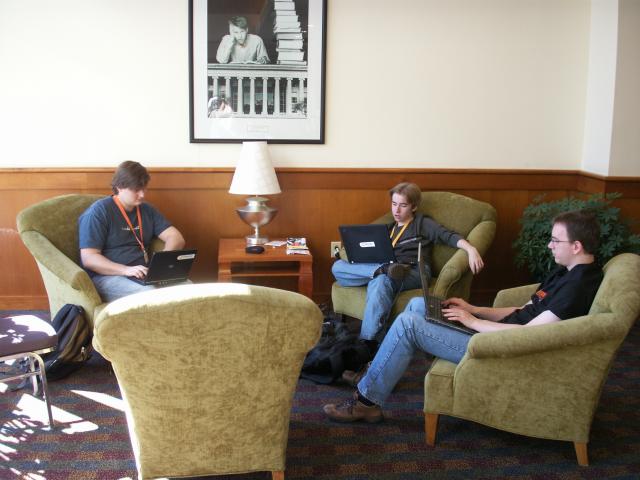
Kristian Lyngstol, Robert Carr and Vincent Untz in the hallway at UDS Boston.


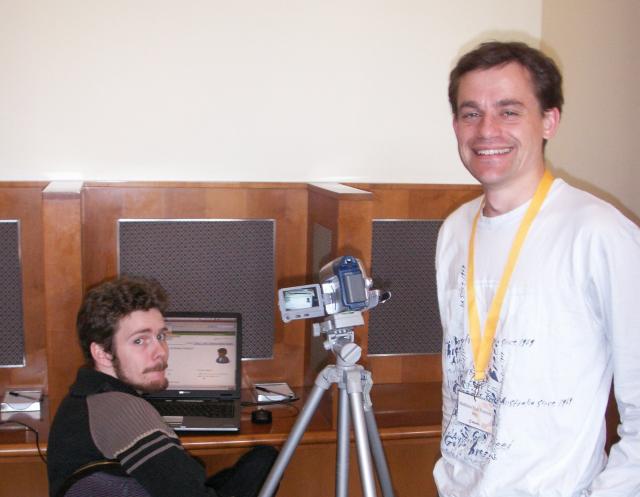
Matthew Paul Thomas tests the usability of Launchpad with Andreas Nilsson in his portable lab.


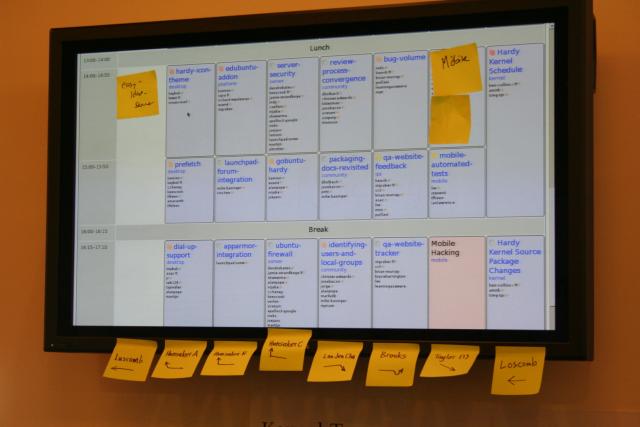
TV with the monday’s schedule of UDS Boston 2007


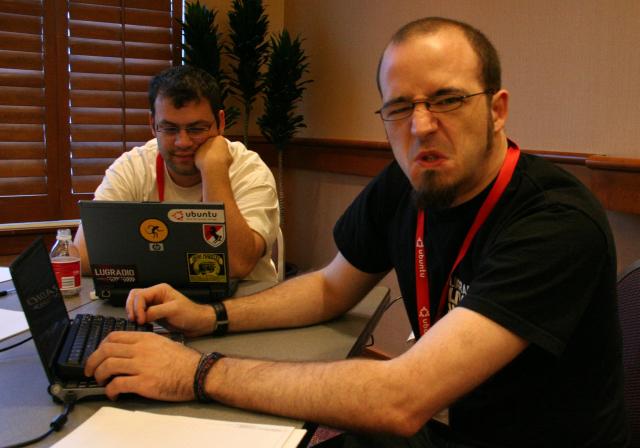
Jono explores his inner rock demon at UDS Boston 2007.

If you have any images of the event, throw them up on Flickr tagged with UDS.

Developer Summit Day 1 finishes

The Ubuntu Developer Summit (UDS) for 8.04 (Hardy Heron), currently underway in Cambridge, Massachusetts, has just finished the first day.

Like previous summits, this UDS starts the first day with an intro talk and then breaks into seperate sessions, usually in tracks such as Server, Mobile, Edubuntu, etc. For a look at what was discussed today, see the day’s schedule.

Every subsequent summit gets bigger and bigger, making it harder for people to get to all the sessions they want or need to and also far too many to talk about here, but here are a few highlights from some of the sessions:

Gobuntu
Gobuntu is the completely free derivative of Ubuntu. Announced last this year and first shipped with 7.10, there is still a lot of work to do. Recent commenters have noticed that Gobuntu ships default Firefox, which includes completely non-free icons. For 8.04, this will be replaced by Epiphany. Firmware is another key issue, with both in and out of kernel firmware is considered non-free. For the out of kernel firmware, it needs to moved to the restricted component and for the in-kernel firmware, this is bit more difficult and will require a seperate kernel, something that should be fixed by the time 8.04 releases. Lastly, the issue of certain multimedia packages might need to moved to restricted from main, although this issue requires more discussion. The gobuntu-hardy spec is now in Drafting.

Telling users about LoCo teams and other local resources
One of the key problems new users face is finding existing local resources, such as their LoCo team. The best place to tell users about these resources is shortly after install. As such, the installer Ubiquity will need to be modified to tell users about where to find these resources, as well as possibly modifying Pidgin to open to the default LoCo IRC channel, not #ubuntu. The identifying-users-and-local-groups is still in discussion, although a session has not been scheduled for tomorrow.

Hardy artwork
There were two discussions of the artwork in Hardy today, one covering the theme and the other about the icons. For the theme, a final idea has not yet been laid down, but the discussion steered toward unifying the Mobile and Desktop themes, keeping the orange elements with less gloss. For the icons, the need to keep the Tango guidelines (although not the icon theme) as well as the need for a palette. The relevent specs, hardy-theme and hardy-icon-them are both currently still in discussion although neither has a session scheduled for tomorrow.

NetworkManager for dialup devices
A great many devices still use the dialup technology of PPP these says, including many cel-based modems such as Edge or HSDPA and ASDL modems using PPP over Ethernet (PPPoE). Thankfully, the next version of NetworkManger, 0.7, will support PPP, although it is not clear exactly how many of these devices will be supported, due to the enormous number of configuration options and different devices in existance around the world. It was further stated that Ubuntu already supports as many ISDN and WinModems as is possible. The dial-up-suport spec is now in the Drafting stage.

Interacting better with upstream
It is critical that Ubuntu has good relationships with our upstream application developers, all the way from the larger projects such as GNOME or KDE down to the very smallest of developers. Generating a set of conventions on how to talk with upstream was the major goal here, including such suggestions as praising publicly, criticizing in private, working with both our direct upstream of Debian and the original application author. The modelling-better-upstream-connections is still in discussion, although another session in not scheduled for tomorrow.

Quote of the Day: John (Maddog) Hall

Stop trying to solve social issues with technical solutions, as it is often more expensive and ultimately not useful.

If you are at UDS and did not see your spec covered, feel free to email the author, Corey Burger with a short summary to be included in the day’s writeup.

And of course, if you want to help out with UDS, all the sessions are broadcast via SIP and the notes are edited on Gobby, a collaborative editor. For more information, see the previous Fridge article on participating in UDS. See you tomorrow!